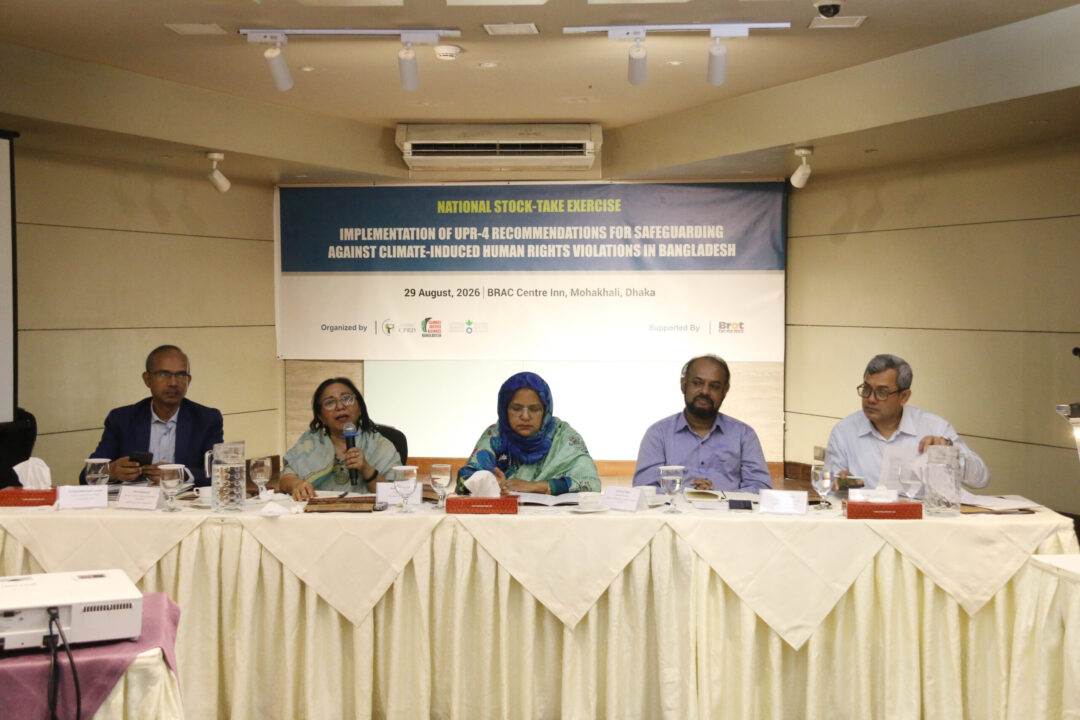
Today, CPRD and HEKS/EPER jointly organized a national seminar titled “Distributive Justice in Bangladesh’s Climate Finance: Challenges and Recommendations for Policy Takeaways” at the Six Seasons Hotel, Dhaka to share the findings of a research conducted by CPRD on climate budget allocation vis-à-vis the climate vulnerabilities in drought-prone and Barind areas of the country in comparison to that in other climate stress areas and discuss feasible policy actions to address the gaps. CPRD conducted the study in Dinajpur, Thakurgaon, Chapainawabganj, Naogaon, and Kurigram districts with support from HEKS/EPER.
The study analysed the 790 BCCTF-funded projects from FY 2008-2009 to FY 2022-2023 and the 262 National Climate Budget-funded projects implemented through 25 ministries and their line agencies in the FY 2022-2023. The study found a lack of distributive justice in the allocation of the funds concerned, corroborated by evidence of significantly lower financing in the drought-prone and Barind areas, compared to other climate-stress areas. The Rajshahi and Rangpur divisions together implemented 143 BCCTF projects, which is nearly half the number of projects in the two coastal divisions Chattogram and Barishal. On the other side, among the ongoing national climate budget projects, only 63 were found under implementation in the drought-prone and Barind areas. The study also explored a clear bias of climate financing towards infrastructural development as well as sudden disaster-driven vulnerabilities, with less importance to the sufferers of slow onset events, particularly, drought. The study findings were presented by Ms. Elmee Tabassum, Research Officer at CPRD.
Explicating the study findings, CPRD Chief Executive Mr. Md. Shamsudohha demanded a systemic reform of the ‘Climate Change Trust Act -2010’ and setting outcome-focused allocation criteria for BCCTF and the National Climate Budget. He further urged for expanding climate budgets and ensuring need-based and equitable allocation thereof. He also stressed the importance of developing a locally-led climate vulnerability analysis and a separate adaptation plan for the plainland indigenous communities and its inclusion in the NAP.

Dr. Fazle Rabbi Sadeque Ahmed, Deputy Managing Director of PKSF) stressed the need to focus on seeking practical solutions based on local needs and existing resources. He demanded ensuring equitable support in the climate stress areas and integration of climate finance across sectors to maximize its impact.
Mr. Corinne Henchoz Pignani, Deputy Head of Mission / Head of Cooperation, Embassy of Switzerland in Bangladesh was present as a ‘Guest of Honor’. She emphasized behavioural change and localized approaches with regard to climate actions. She further reminded that true progress in climate action and justice could be achieved only when the strategies are own and developed by the local communities whom the actions are targeted to.
Honorable former MP, Mr. Rana Mohammad Sohail, underscored the essentiality of capacity development at the local level to ensure development of competitive and quality project proposals from the field level to be qualified for funding. He proposed a thorough review of the project selection criteria matrix, taking into account the intersection of climate change trend, vulnerability, human dimension, and political economy.
Among others, Barrister Shameem Haider Patwary, Former MP, Mr. Iqbal Abdullah Harun, Additional Secretary, MoEFCC, Mr. S. M. Mahbub Alam, Joint Secretary, Road Transport and Highways Division, Mr. Md Ziaul Haque, Director, Air Quality Management, Department of Environment, Mr. Mirza Shawkat Ali, Director, International Conventions, Department of Environment, Ms. Shirin Lira, Programme Manager, Governance, Climate Change and Environment, Embassy of Switzerland in Bangladesh, Mr. M Zakir Hossain Khan, Chief Executive, Change Initiative, and many other policy stakeholders, senior officials from government bodies, CSOs and development organizations spoke at the event.
Expressing concern over failure to addressing the diverse and complex climate vulnerabilities across locations, Ms. Dora Chaudhuri, Country Director of HEKS/EPER, stressed the need for equitable and gender responsive allocation of national climate funds and concluded the seminar with a vote of thanks to all present.