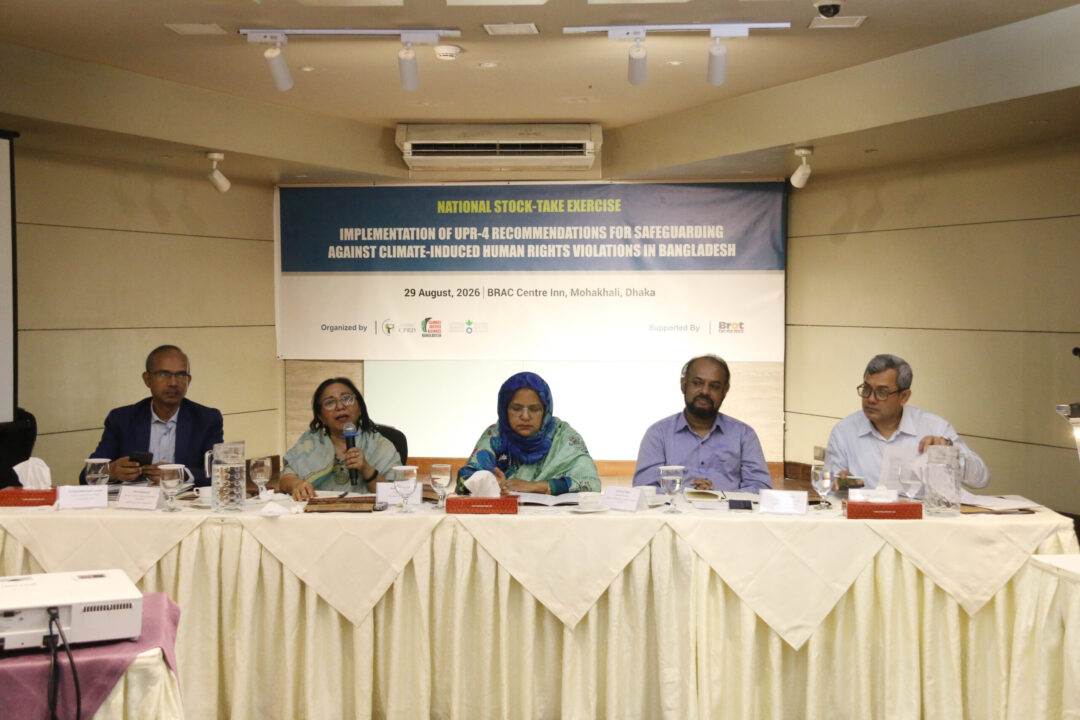
On September 29-30, 2025, the Center for Participatory Research and Development – CPRD, in collaboration with WaterAid Bangladesh, World Resource Institute and ACME AI, hosted a 2-day stakeholder workshop titled “Climate Resilient Green Accountability for WASH” at the A S Mahmud Seminar Hall, The Daily Star Center in Dhaka.
The workshop presented a comprehensive range of thematic sessions related to WASH, beginning with the climate finance architecture & institutional integration of WASH; barriers in tagging, access and mobilization in enhancing transparency and accountability therein. Distinguished experts and practitioners including Partha Hefaz Shaikh, Sadhli Roomy, Md Shamsuddoha, Sumaiya Binte Anwar and Shanjia Shams facilitated these sessions.


The workshop focused on the following key discussions:
- WASH Under-Integration in the Multi-Layered Finance System: Bangladesh has a five-tier architecture linking global climate funds (GCF, AF, GEF), national regulators (ERD, MoEFCC, Finance Division), implementing entities (PKSF, IDCOL, UNDP, World Bank), executing line ministries/local governments, and end-users. Despite institutional maturity, sanitation, hygiene, FSM, and gender-responsive outcomes remain marginalised in both allocations and implementation.
- Fragmented External Channels: Bilateral and multilateral partners finance climate-sensitive WASH largely outside climate-fund windows. These parallel flows are weakly captured in national tagging systems, reducing accountability and gender responsiveness.
- National Gatekeeping and Coordination: ERD, as NDA to the GCF, aligns proposals with NAP, NDC and the Country Programme but linkages between WASH coordination platforms (like the WSS&U Working Group) and climate finance governance remain weak.
- Equity Gaps in Allocation: Metro-centric financing (Dhaka, Chattogram, Rajshahi) overshadows major hotspots (salinity belt, haors, hill tracts).
- Domestic Climate Budgeting: Bangladesh’s Climate Budget tags spending across 25 ministries (Tk 42,206.89 crore in FY2024–25) but reports allocations rather than disbursements or results. Budget Code 0108 for WASH adaptation rose from BDT 946 crore in FY2019–20 to BDT 1,986.92 crore in FY2024–25, still <5% of climate-relevant ADP.
- Private Sector Potential: Bangladesh Bank’s green facilities (Green Transformation Fund, Green Bonds, CSR) could support WASH but are rarely applied due to risk perception, lack of pipeline and standards.
- Political Economy: The WASH governance system in Bangladesh is influenced not only by its environmental vulnerabilities but also by political dynamics, institutional structures, and resource allocation mechanisms that shape who benefits from WASH resources and who is excluded. At the community level, political connections often dictate who gets access to WASH resources, such as water tanks and sanitation facilities, leaving the most vulnerable households underserved.
- Financial and Technical Sustainability Issues: Many WASH projects rely heavily on external funding but fail to develop sustainable, local financing mechanisms. Most NGO and CSO projects at the grassroots level are time-bound and project-based, leading to deterioration of infrastructure after the project ends.
Representatives from different civil society organizations from the grassroots level were also present at the event and contributed to the discussions. This event concluded with an Expert Meeting where Alok Kumar Majumder, Director – Programme & Operations at the Red Orange Limited, Abu Sadat Moniruzzaman Khan, Programme Head of CCP, BRAC, Mohammad Mahmodul Hasan, Head of Program – Water, Food and Climate at Helvetas Bangladesh, and Mohammad Abdul Wazed, Senior Fellow and Program Advisor at PPRC, attended as experts and reiterated that climate finance for WASH in Bangladesh still remains fragmented, loan-heavy, and inequitable. They advocated for the effective implementation of Green Accountability Platform that prioritizes transparency, citizen participation, and digital innovation to ensure that financing effectively benefits the most vulnerable communities.