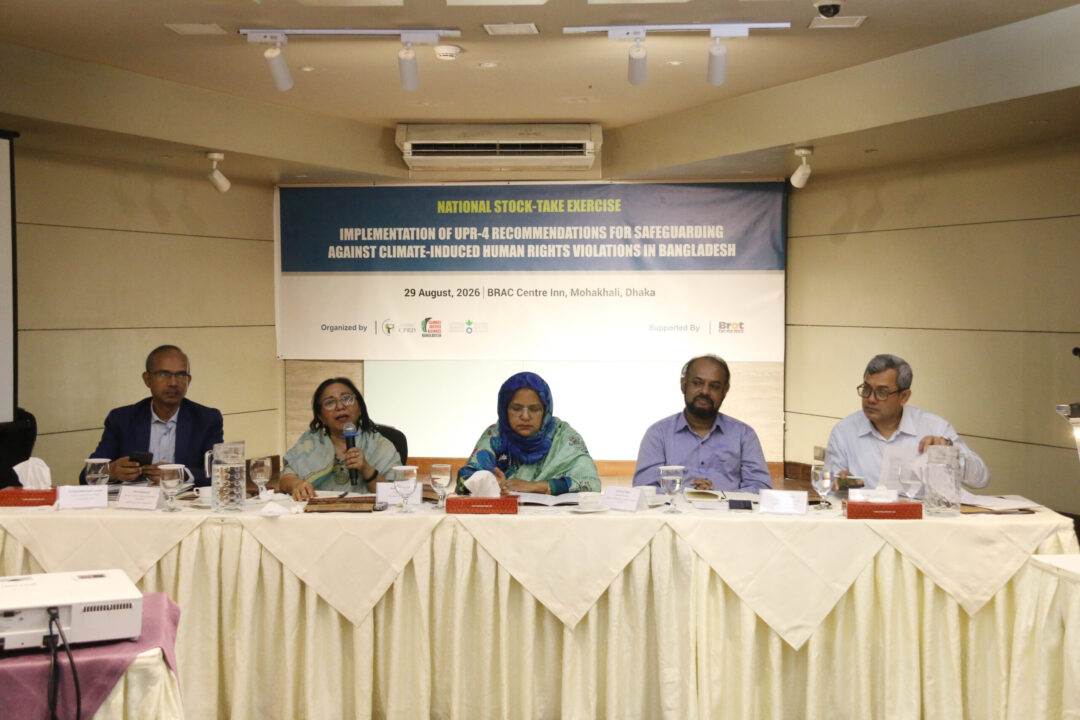
6 December 2025 | BRAC Centre Inn, Mohakhali, Dhaka
CPRD, together with the Climate Justice Alliance Bangladesh (CJA-B), hosted a national seminar titled “COP30 Outcomes: Promise, Performance and the Politics In Between.” The event brought together senior government officials, academics, negotiators and civil society leaders to unpack what the Belem Political Package means for a climate-vulnerable country like Bangladesh.
The discussion was engaging and honest. While participants acknowledged a few positive steps at COP30, they also underlined how far the summit fell short of the expectations of vulnerable
Purpose of the Seminar
- The session aimed to
- Review COP30 outcomes against expectations,
- Unpack the politics behind the negotiations,
- Help policymakers and CSOs understand what the decisions mean for Bangladesh, and
- Identify advocacy priorities for COP31.
Speakers and Participants
The discussion was facilitated by Md Shamsuddoha, Chief Executive of CPRD and National Coordinator of CJA-B. A detailed outcome presentation was delivered by Sheikh Nur Ataya Rabbi, Assistant Manager, Research and Advocacy, CPRD. In his keynote, Sheikh Nur Ataya Rabbi walked everyone through the key outcomes and highlighted the limited wins:
- The Global Goal on Adaptation finally got its indicator framework,
- The Loss and Damage Fund opened its first call,
- Adaptation finance was promised a tripling,
- Article 9 received a clearer follow-up process.
But he noted that these steps were overshadowed by major gaps—no fossil fuel phaseout roadmap, no deforestation roadmap, weakened GGA indicators, and few enforceable finance decisions.
Md Shamsuddoha shared a political assessment of COP30. He noted that although the new Loss and Damage Report represent progress, the summit did not succeed in motivating developed countries to provide meaningful financing to the FRLD. He added that much of the Belém Political Package relied on soft language, with only a small number of decision paragraphs carrying firm commitments. He also commented on climate-related trade policies, saying that while institutionalizing dialogue is positive, Bangladesh needs stronger media engagement, coordinated civil society advocacy, and better national readiness to access upcoming finance windows as the country prepares for COP31.


Global politics shaping the negotiations
Md Ziaul Haque (DoE) described the shifting global politics behind COP30. He pointed out widening fractures inside the Global South oil exporters and India forming a defensive block while countries like Bangladesh, Bhutan and Nepal are exploring a small resilience coalition to strengthen bargaining power. He also highlighted unresolved finance debates around Articles 9.4 and 9.5, and the persistent lack of an agreed definition of climate finance.
Dr Shah Abdul Saadi, Economic Relations Division Bangladesh, warned that unilateral trade measures (UTMs), now framed as climate-friendly, could become a new form of green protectionism. He also stressed the need for stronger capacity to use Article 6 mechanisms.
Additional Secretary A K M Sohel, ERD noted the heavy presence of fossil fuel lobbyists at COP30, which he believes contributed to shelving the fossil fuel phaseout roadmap.
Dr Fazle Rabbi Sadek Ahmed (PKSF) shared that Bangladesh missed two funding opportunities due to internal bottlenecks, calling for tighter coordination and readiness. He also reminded that developed countries must take genuine domestic mitigation action, given their historical responsibility.
Speakers also flagged the tight timeline for GST-2, given that the next IPCC report may arrive too late to guide NDC3 and finance cycles. Several noted growing attempts to dilute the centrality of the 1.5°C goal and weaken language on fossil fuel phaseout.
Across the room, there was a shared view that the Mitigation Work Programme still lacks direction and that multilateralism, despite its struggles, remains the only platform that vulnerable countries can rely on. Dr M Asaduzzaman reminded that the system often struggles to secure consensus, yet it remains essential for long-term global cooperation. He stressed the urgency of reaching net-zero emissions as quickly as possible for the sake of future generations.
Speakers also noted that developing countries fought hard in Belém to keep indicators facilitative rather than punitive, to protect national space, and to push back against benchmarks that could turn into conditionalities. These debates reflect a deeper worry about fairness and power imbalances.
So where does Bangladesh go from here?
Bangladesh now needs to focus on a few clear priorities ahead of COP31. These include building a Bangladesh–Bhutan–Nepal resilience cluster, improving readiness for rapid funding opportunities, strengthening cross-ministry coordination to develop strong finance pipelines, and aligning national work with nature–climate frameworks. The seminar’s final message was straightforward: COP30 delivered limited progress, and the harder work begins now. Bangladesh must be more coordinated, more prepared and more assertive, and CPRD and CJA-B remain committed to supporting that effort with evidence, analysis and collective action.