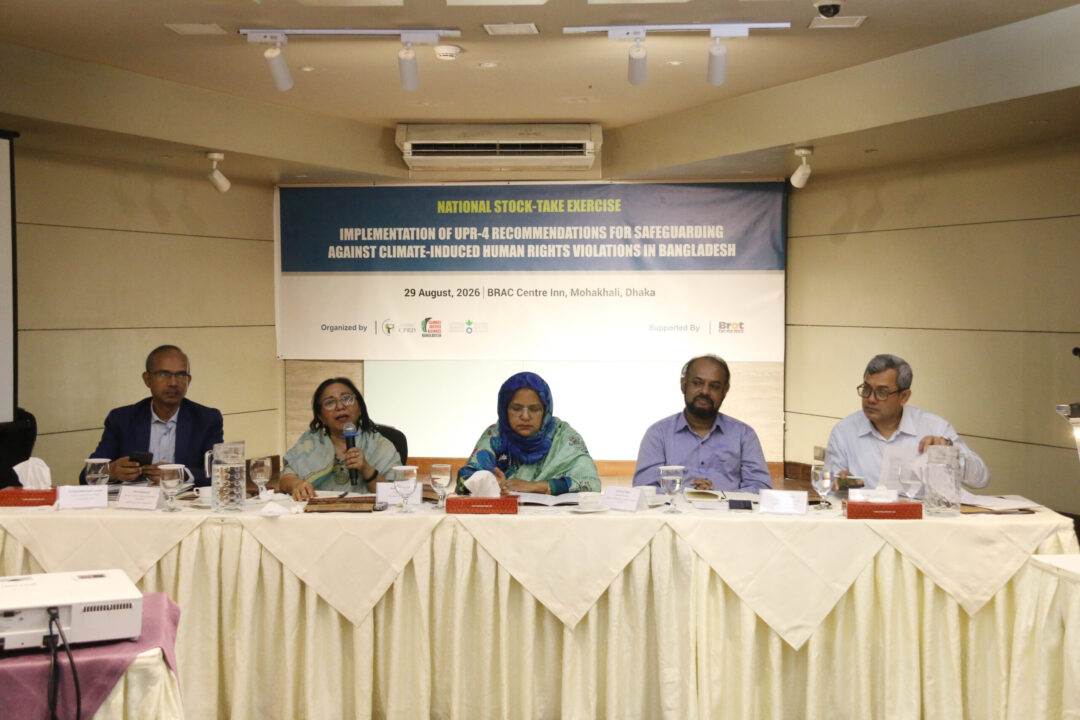
As climate impacts intensify across Bangladesh, vulnerable households are facing growing financial stress from floods, salinity intrusion, erratic rainfall, heat stress, and displacement. Farmers, fisherfolk, women-led microenterprises, and informal workers often rely on short-term coping strategies such as asset sales or informal borrowing, which gradually erode long-term resilience. At the same time, financial service providers struggle with credit risk, regulatory limitations, and operational barriers that restrict the expansion of climate-responsive financial products.
To respond to these challenges, CPRD, in collaboration with MicroSave Consulting (MSC), convened a joint design solution workshop that brought together regulators, financial institutions, climate practitioners, researchers, and development partners. The workshop aimed to bridge climate and financial perspectives through a structured co-design process, focusing on solutions that are practical, context-specific, and feasible within Bangladesh’s regulatory and institutional landscape.
Key Themes from the Discussions
A central theme across sessions was the need to move beyond fragmented, post-shock responses toward anticipatory and adaptive financial systems. Participants emphasized that while climate and risk data are increasingly available, they remain fragmented and underutilized, limiting their translation into timely financial action.
Discussions highlighted that climate risk should not be borne solely by vulnerable households, particularly smallholder farmers. Instead, risk-sharing mechanisms across farmers, financial institutions, insurers, development projects, and the state are essential to building sustainable resilience.
Working Group Insights
The workshop featured two focused working groups. One explored technology-enabled climate risk financing, examining how existing climate data could be better integrated into financial systems to enable anticipatory payouts, parametric insurance, and early action before climate shocks occur. Participants stressed the importance of strengthening data infrastructure, improving interoperability, and piloting solutions in flood-prone areas.


The second working group focused on financing climate-resilient agriculture for smallholder farmers. Key discussions centered on aligning financial tools with local agro-ecological realities, promoting integrated farming systems, and ensuring continuous capacity building rather than one-off interventions. Blended finance approaches combining grants, concessional credit, savings, and insurance emerged as promising pathways, particularly when paired with digital advisory services.
Reflections on Inclusivity and Scale
Reflections from senior practitioners underscored persistent gaps in inclusivity and scale. Speakers highlighted that women farmers and marginalized groups remain underrepresented in data, financing mechanisms, and product design, despite playing critical roles in adaptation and resilience-building. Others emphasized that Bangladesh’s challenge is not the absence of data or experience, but the need for better coordination, integration, and governance to translate these assets into operational solutions.
Way Forward
The workshop demonstrated the value of cross-sector collaboration in developing climate-resilient financial solutions that balance impact with real-world constraints. Key takeaways included the need to strengthen data-to-decision pathways, promote shared risk allocation, and design inclusive delivery mechanisms that reach those most exposed to climate risks.