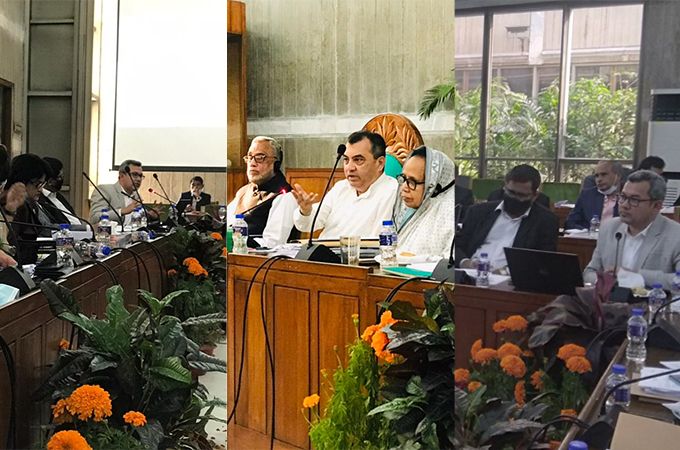
A CSOs Group comprising of 25 organization and led by CPRD was invited to share its perspective on the outcomes of COP 27 to the 33rd Meeting of the Parliamentary Standing Committee, Ministry of Environment, Forest and Climate Change (MoEFCC).
Md Shamsuddoha, Chief Executive-CPRD, along two other members of the CSOs group, joined the meeting on 29th January 2023 at the Cabinet House of National Parliament. Mr Saber Hissin Chowdhury, MP, Chairperson, Parliamentary Standing Committee, Mr Md. Shahab Uddin, MP, Minister, MoEFCC, Ms Habibun Nahar M.P, Deputy Minister, MoEFCCC, Dr. Farhina Ahmed Secretary, MoEFCC, Senior officials of the Ministry, Department of Environment, Department of Forests were present in the meeting.
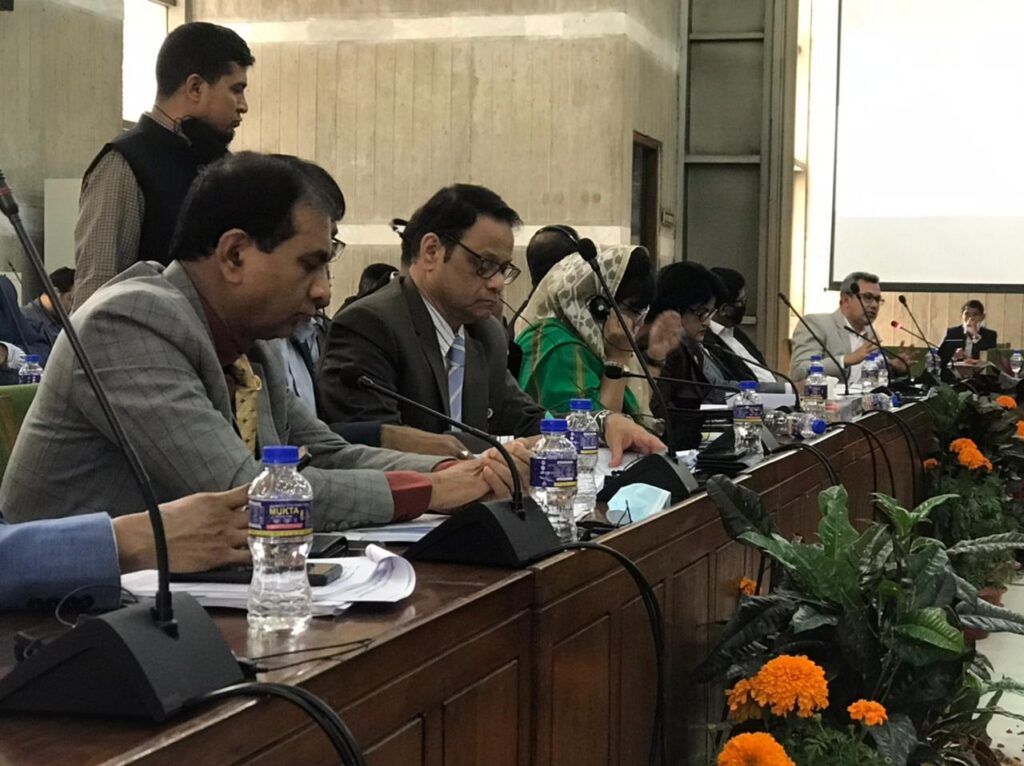
The CSO’s perspective on the outcomes of COP 27 has raised critical concerns on a few issues e.g.,
- COP 27 failed to expedite the political momentum created at COP 26 to limit global average temperature rise to 1.5 degrees Celsius through ‘phasing out’ Coal and other fossil-fuel. Instead, the COP provided an increased space for gas and LNG in the name of using “low emissions’ energy. The paradoxical position of EU e.g., shifting focus to Africa for gas and hydrogen fuel provoked the energy colonialists e.g., Saudi Arabia, Russia and China to make profit over the planet.
- The second technical dialogue of the global stock-take (GST) was held in the first week of COP 27 (in SB 57). The dialogue ended with the disagreement on types and sources of information to be considered in GST process, also failed to agree how the issues of L&D and associated financial need will be captured in GST. The COP took a ‘non-conclusive’ decision on the issues, deferred the discussion to the UN Climate Summit in September 2023 to build a political momentum on the comprehensiveness of GST process.
- The current GST process does not consider an assessment for L&Ds, which in turn foreclosed the scopes of establishing a systematic process of collecting, recording, and reporting L&Ds and accounting associated financial needs.
- Decisions on the establishment of L&D Funding Arrangements emphases minimizing L&Ds with a range of ex-ante measures, which presumably are linked to the measures of mitigation, adaptation, DRR, Risk Transfer, Early Warning Systems etc. In contrary to those, ex-post measures of addressing L&Ds like paying-off or offsetting post-disaster and recurrent L&Ds resulting from the residual impacts of sudden onset and slow onset events etc. are grossly ignored, so the non-economic L&Ds.
- There are significant amount of discussion and strengthen argument from the developed countries, US in particular, for creating an enabling legal, regulatory and monetary environment to de-risk private investment while risking public/national financial markets. The argument of ‘de-risking’ private investment has been a widely communicated political message when the scopes of public investments towards ‘global common cause’ are gradually declining in the context of newly emerged geopolitical tensions, energy competition, recession and inflation, debt pressures etc. While, de-risking of private investment has been appeared as a convincing financial speak in terms of “mobilizing private finance” or “blended finance’, however details on this are yet to understand. Essentially re-risking will safeguard private investment, but not sure whether this will make energy transition green and just.
The presentation instigated very focused follow-up discussion. Mr Saber Hossain Chowdhury raised several issues for consideration by the ministry and its allied department e.g., a) developing a common policy/political understanding on the financing arrangements of L&D, and undertake measures to influence to COP/transitional committee of L&D Finance on establishing a balanced focus in responding and addressing L&Ds, b) Strategize position on GST, especially how to include L&Ds and associated financing needs in the GST process, c) developing a comprehensive understanding on the measures of ‘re-risking’ private investment, develop coordination with the Ministry of Finance to understand financing schemes of the MDBs. Mr Chowdhury asks the ministry to establish ‘formal coordination’ with the CSOs to expedite the scopes of capacity building and common positioning at the global negotiation.