Antalya, Türkiye | 17 November 2026
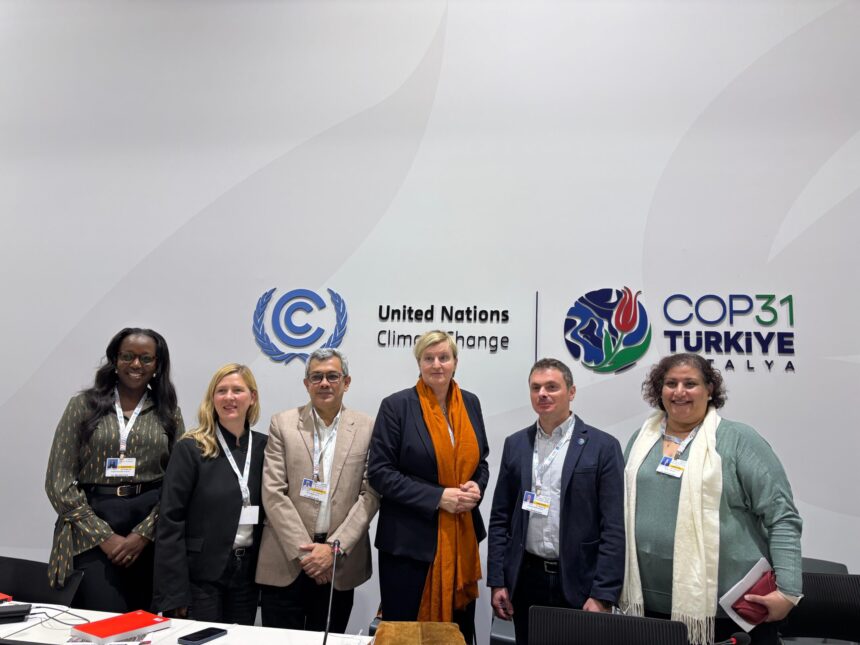
A panel discussion titled “Migration and Security Challenge” was held at COP31 in Antalya, Türkiye, bringing together climate experts and development practitioners to examine the growing links between climate change, human security, livelihood insecurity and forced displacement. The discussion emphasized the urgent need for equitable, predictable and locally led adaptation finance to strengthen the resilience of vulnerable communities.
Md Shamsuddoha, Chief Executive of the Center for Participatory Research and Development (CPRD), Bangladesh, highlighted the complex humanitarian and climate challenges in Cox’s Bazar, where more than 1.2 million Rohingya refugees face overlapping vulnerabilities. He discussed how extreme weather events, environmental degradation, limited livelihood opportunities and pressure on essential services are affecting both displaced populations and host communities. He emphasized the importance of sustained international support, particularly for education, healthcare, livelihood protection and long-term community resilience.


Rania Rashad of the Coptic Evangelical Organization for Social Services (CEOSS), Egypt, discussed how increasing temperatures, water scarcity, salinity intrusion and declining agricultural productivity are threatening rural livelihoods and contributing to migration. She highlighted community-based adaptation initiatives, including participatory climate risk assessments, farmer field schools, solar-powered irrigation and climate-resilient agricultural practices.
Antoine Abdelmassih of CEOSS addressed the interconnected challenges of ecological degradation, water insecurity and human vulnerability across the Middle East and North Africa (MENA) region. He emphasized the importance of people-centred climate risk assessments, integrating scientific knowledge with local practices, and strengthening community and youth participation in adaptation planning.
A major highlight of the session was the presentation of the ‘Climate Adaptation Finance Index 2026’ by ‘Rev. Dr. Dagmar Pruin and Sabine Minninger of Bread for the World’. The findings revealed that more than 70 developing countries remain severely or extremely underfunded despite facing significant climate risks. Approximately 6.3 billion people in the Global South live in countries receiving inadequate adaptation finance. The speakers called for vulnerability-based financing allocations, greater access to grant-based public finance, simplified funding mechanisms for fragile and conflict-affected countries, and stronger accountability in climate finance delivery.
The interactive discussion further explored how participatory risk assessments and community-driven adaptation priorities can help bridge the gap between local climate vulnerabilities and international financing mechanisms.
Strengthening Climate Resilience Through Equitable Finance
The discussion reinforced that climate-induced displacement is not solely a humanitarian or migration challenge but also a consequence of deep-rooted inequalities in climate vulnerability, livelihood opportunities and access to adaptation resources.
Panellists collectively emphasized that addressing these challenges requires stronger international cooperation, sustained investment in climate-resilient livelihoods, and adaptation finance that responds to the actual needs of frontline communities.
The session concluded with a central message: protecting human security and reducing forced displacement require timely, accessible and equitable adaptation finance that enables vulnerable communities to build resilience before migration becomes their only survival option.
The discussion contributed to the broader COP31 dialogue on climate justice, adaptation finance and the importance of placing vulnerable communities at the centre of global climate action.