Climate Justice Alliance Bangladesh (CJA-B)— a national platform of 35 national and international NGOs and CSOs— organized a 3-day workshop titled “Capacity Building and Strategy Workshop: Framing CSOs position on COP29 and Beyond” from 24th May to 26th May 2024 at BRAC CDM, Rajendrapur, Gazipur. The workshop aimed to develop a comprehensive understanding of the scientific and political economy perspectives of climate change and key debated issues of climate negotiation and facilitate a common CSOs position towards COP 29 and beyond.
The workshop was organized focusing on three thematic areas:
- Science of climate change and its impacts
- Global policy and politics around climate change
- Defining CSOs strategy and position on COP 29
The workshop discussed several issues of national as well as global policy interest, which include:
i) Understanding climate change from its science-based causes and impacts (reflection form the IPCC’s Sixth Assessment Report)
ii) Climate change-induced displacement and migration, health issues, etc.; implication of climate change impacts on human rights
iii) Climate change-focused national policies of Bangladesh
iv) Gender dimension of climate change impacts with evidence from the communities displaced by river-erosion
v) Fundamentals of global negotiation on climate change along with the historical background and milestones
vi) International cooperation & collaboration to address climate impacts in Bangladesh
vii) Stocktaking of the outcomes of COP 28 and expectation from COP 29
viii) Key Issues of climate change negotiation— Mitigation, Adaptation, Finance, and Loss & Damage
The technical sessions were facilitated by Mr. Md Shamsuddoha, Spokesperson of the CJA-B and Chief Executive of Center for Participatory Research and Development- CPRD, Mr. Mohammed Mofizur Rahman, Scientist at the Potsdam Institute for Climate Impact Research (PIK), Germany, Mr. Dharitri Kumar Sarkar, Deputy Secretary at the Ministry of Environment, Forest and Climate Change, Ms. Nayoka Martinez Bäckström, First Secretary for Environment & Climate Change and Deputy Head of Development Cooperation, Ms. Rabeya Begum, Executive Director at Shariatpur Development Society (SDS), Mr. Mohammad Shahjahan, Director at Young Power in Social Action (YPSA), Mr. Mrityunjoy Das, Deputy Director, Humanitarian & Climate Action Program at CARE, Mr. Mohammad Mahmodul Hasan, Domain Coordinator for Water, Food, and Climate at Helvetas Swiss Intercooperation, Mr. Anwar Hossain, Deputy Program Manager at Islamic Relief Bangladesh, Mr. Sheikh Nur Ataya Rabbi, Assistant Research & Advocacy Manager at CPRD, and Ms. Elmee Tabassum, Research Officer at CPRD.
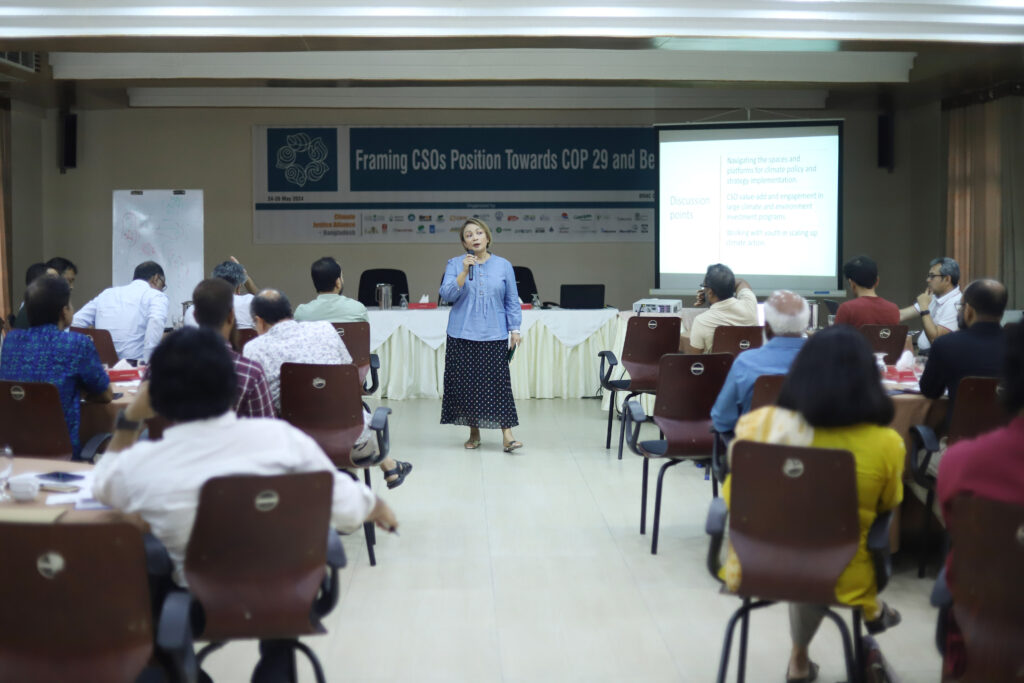
The technical sessions were followed by the “CSOs Strategy-Framing Session,” which discussed CSOs position on the key issues of high importance at COP 29. The session started with a rundown of the previous two days’ sessions and a group discussion on CSOs expectations and positions on Mitigation (NDCs), Climate Finance, Funding Arrangements for Addressing Loss and Damage, Global Stocktake, Adaptation, and Human Rights. The Civil Society Organizations (CSOs) collectively recognized climate crisis as a systemic failure. Accordingly, they agreed to advocate for an appropriate development model based on a precise and equitable political stance in the upcoming Conference of the Parties (COP). Furthermore, the CSO Group emphasized taking action rather than relying solely on negotiations. As a result, the CSOs reached a common agreement on further elaborating the key aspects of Bangladesh’s position and agreed to a series of advocacy events towards COP 29 and beyond.