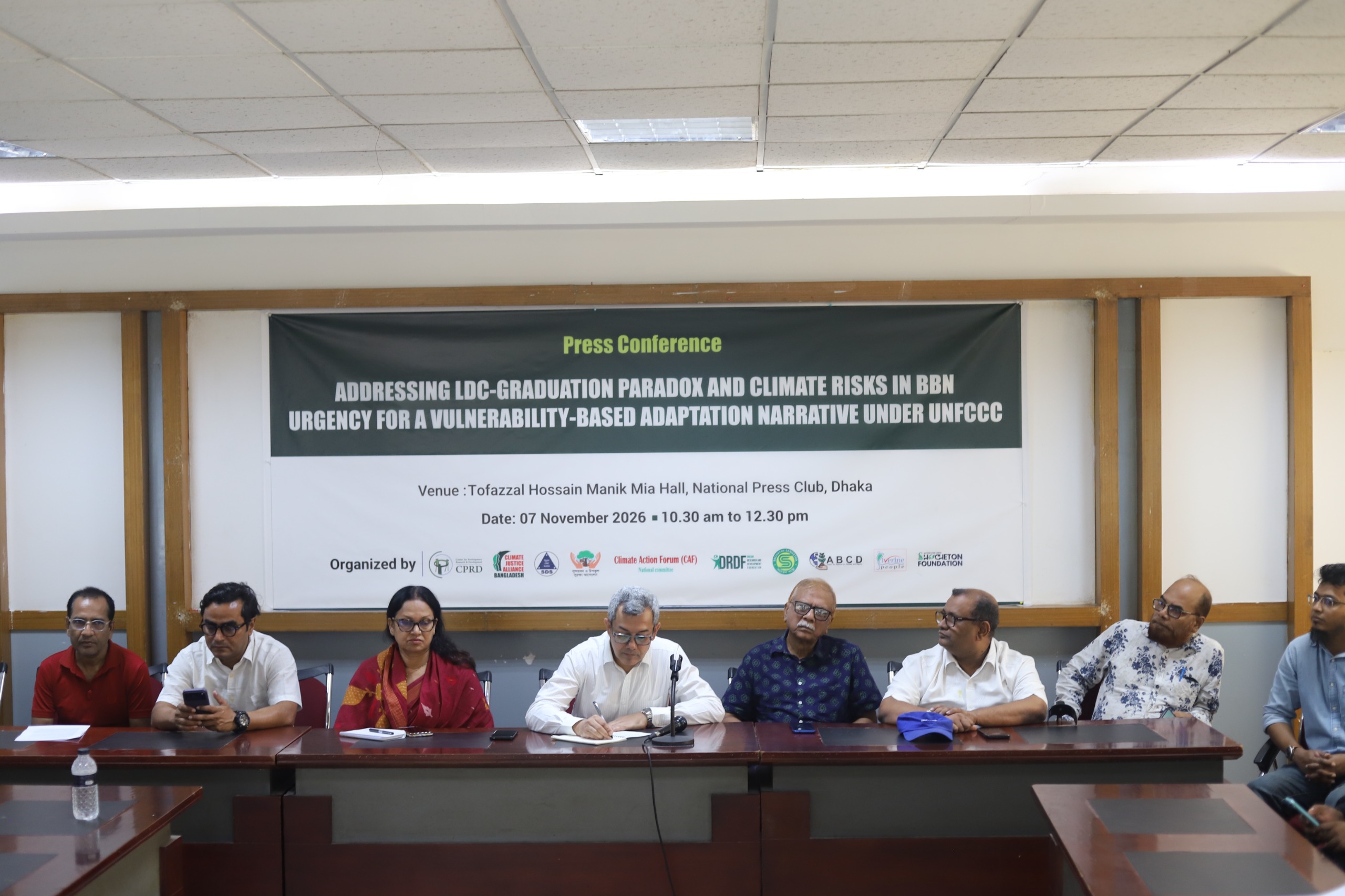
Today, 20 December 2022, a press event titled “CSO’s Call on Human Rights Day 2022: Respect, Promote and Consider Human Rights in all Climate Actions” was held at Johur Hossain Chowdhury conference hall, National press club, Dhaka at 11:00 am organized by Center for Participatory Research and Development- CPRD.
The program was presided over by Mr. Md Shamsuddoha, Chief Executive of CPRD. Khodeja Sultana Lopa, Country Director of Diakonia; Ashish Barua, Climate Change and Sustainable Development Programme Manager at Helvetas; Shahnewaz Whara, Regional Climate and Resilient Advocacy Manager at Practical Action spoke as special guests at the event. Md. Akib Jabed, Project Coordinator of CPRD gave a comprehensive presentation on the findings of recent research work conducted by CPRD.
As the Chair of the event, Mr. Shamsuddoha said, CPRD is in search of different and multi-faceted vulnerability at individual and community level in different regions affected by climate change. Several research and investigation activities have already been conducted by CPRD. We have seen in the studies that climate change is creating obstacles in the access of the affected communities to food, water, clothing, shelter, medical care, education and above all depriving the affected communities of the right to live a quality life. Research also shows that human rights violations depend on the social, geographic, economic condition and gender identity of the victimized community’s or individual. The human rights of women who are financially weak or physically challenged are the mostly violated. Climate change is undermining the human rights of affected communities on several ways and stage. It begins with the destruction and damage during the disaster’s events and secondary and tertiary human right violation begins after the disaster (post-disaster period), it brings extreme sufferings to the lives and livelihood of the affected population.
The issue of human rights violations as a result of the impact of climate change was also seriously presented in the special report of the United Nations organ UN-HCHR in 2009. The report shows that people displaced and migrated by climate change are still subjected to human rights violations at some stage of displacement. Even though climate-vulnerable populations migrate to vulnerable areas, especially urban areas, they are exposed to different types of risks such as food insecurity, health risks and problems in accessing health care, labor discrimination, child labor, sexual harassment, the risk of trafficking, child marriage, etc.
Taking into account the 2009 report of the UN-HCHR, the United Nations Framework Convention on Climate Change (UNFCCC) agreed in 2013 that all actions to combat climate change should uphold all human rights. Later, in 2015, the Paris Climate Agreement adopted by the states decided that the states should ensure the protection of human rights in all activities to combat climate change. There is no legal framework in this regard to entrust the responsibility of protecting human rights due to climate change to the state. On the other hand, the ongoing human rights protection policy, especially the Universal Declaration on Human Rights (UDHR), has not raised the issue of human rights violations due to climate change. Again, states are also not very proactive in protecting human rights which are being violated due to the impacts of climate change. Because the historical responsibility for climate change lies not with developing and underdeveloped countries.
In this situation, realizing the devastating consequences of climate change in Bangladesh and considering the deterioration of the human rights situation, there is no option other than creating a new legal framework for the protection of the human rights of the climate victims and raise the matter before the international community to ensure reparation for the sufferers who are bearing the utmost brunt of climate change.
In his keynote presentation, Mr. Jabed demonstrated the climate change induced sufferings and subsequent human rights violation which were explored from a recent study carried out by CPRD at Shariatpur district. Focusing the chain and residual impacts of river bank erosion, this research was carried out on river bank erosion induced displaces at Naria and Zanjira Upazilas of Shariatpur district. The study found that displaces have not only lost their household, assets and standing crops in bank erosion of Padma River, but also bearing the secondary and tertiary impacts caused by river bank erosion, e.g., identity crisis in newly settled location, wage discrimination for women and forced labor, increasing incidence of child marriage and child labor, school dropout and social insecurity at newly resided place due to the absence of male family member etc.. These situations directly violate the ‘Right to life and security’, ‘Right to self-determination’, ‘Right to means of subsistence’, ‘Right to standard living including adequate houses, food, water, sanitation’ etc. of these displaces.
Khodeja Sultana Lopa said that there is no longer any debate about climate change being a human rights concern, conducted all research works results are the proof of the issue, but more research should be continued on the issue of human rights violation to minimize the loss and damage in the grassroot level. We seek national and international policy in light of grassroot realities. She also said, if the global policy makers as well as Bangladeshi policy makers do not play an active role for the people who are in danger and deprived of their rights, more terrible disasters will befall Bangladesh.
Shahnawaz Whara said thanks to CPRD for organizing the event. We hear stories of deprivation and disenfranchisement from the people in the coastal areas and newspapers, but we don’t see significant initiative from the national and international level!
In his speech, Mr Ashish Barua said the nexus between ‘Human Rights and Climate Change’ has already been proven globally. In Bangladesh, change-induced disasters are violating the fundamental rights of marginalized people. The articles of UDHR were formulated back in the 1950s that don’t comply with the current situation of climate change impacts and subsequent violations of human rights.
Besides experts, policy makers and CSOs participants who work on climate change and human rights expressed their views at the press event.