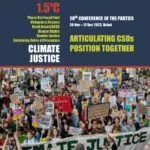
The Climate Justice Alliance- Bangladesh, a platform of 42 CSOs and development partners secretariat by the Center for Participatory Research and Development- CPRD, convened a press briefing event titled “COP29 Outcomes: North-Persuaded Neoliberal Policy Instruments Failed the Climate Justice” on 27th November 2024 at the Tofazzal Hossain Manik Mia Hall, National Press Club in Dhaka. The event aimed at depicting the scenario of achievements drawn from the recently concluded COP 29 against expectations from it.
A critical analysis of the COP29 key outcomes on different agendas has been presented by Sheikh Nur Ataya Rabbi, Assistant Manager at CPRD and Shanjia Shams, Research Officer at CPRD. The presenters highlighted the adoption of the New Collective Quantified Goal with an increased rate of $300 billion annually by 2035, along with an ambiguous aspiration of reaching $1.3 trillion. What’s more, after ten years of discussions, COP29 has finally agreed on rules of carbon trading under Article 6 of the Paris Agreement, which makes the carbon market fully operational. The regulations regarding international carbon trading under Article 6.2 and a centralized carbon market under Article 6.4 have now been finalized, however, they are flawed by issues with accountability mechanisms and significant complexity. The COP29 underscored and encouraged creating fiscal space in developing country Parties through the use of innovative instruments, such as first-loss instruments, guarantees, local currency financing and foreign exchange risk instruments, which indicates a clear motive of the developed countries to embed neoliberal instruments in the climate finance regime, which directly contravenes climate justice.
Moderator of the program, Md Shamsuddoha, Chief Executive at CPRD emphasized that the NCQG target of USD 300 billion by 2035 is too low compared to the needs, and the horizon of meeting the target is too far; there is no clarity on instruments— grants or loan, lack of clarity on sources; it involves all actors to achieve 1.3T target by 2035 without placing sole responsibility on developed countries. The finance decision aims to promote the private sector as a major contributor to climate finance, which risks profit-oriented instruments, predominantly loans and other neoliberal financial instruments, being extensively used to meet the goal and fail climate justice thereby.
Shamsuddin Illius highlighted that COP presidency has been following a common practice of pushing decisions for endorsement by parties at the eleventh hour, allowing little space for final effective negotiation from the developing countries. This clearly indicates a colonial mindset of the developed countries to forcibly impose their models on the weaker nations with no remarkable protests from the latter. COP29 decision texts, particularly, on NCQG have also been finalized in a similar fashion disregarding the voices of the global south. Developed countries, in a manipulative manner, moving towards transferring the financial responsibility onto the developing countries is creating trend risks fostering a form of neo-climate colonialism, undermining the principles of fairness and equity in climate negotiations, Mr. Illius expressed.
Dr. Suborna Barua, Professor at University of Dhaka, criticized the loophole game by the developed countries with regard to climate finance. “The section 8(c) of the NCQG text has given formality to the financial flows through MDBs, significantly eroding the space for the developing countries to argue for grants-based climate finance in the future COPs”, he added.
Manish Kumar Agrawal, Country Director at Concern Worldwide said, “The COP29 decision on setting indicators for ‘enabling factors for implementing adaptation action, including the MOI’, created a room for developed countries to impose conditions of transparency and governance against adaptation finance demand from the developing countries, which may ultimately hamper the real progress in adaptation.”
Md Ziaul Haque, Director, Air Quality Management, Department of Environment, Bangladesh, said “COP29 was expected to ensure MWP provide guidance on 1.5 degree Celsius aligned NDC-3, the draft decision did not even refer to the 1.5-degree Celsius goal; it missed the chance to send high-level messages on the NDC update process. He also said that while COP29 finalized the standards for centralized carbon market, no accountability mechanism has been directed from COP29.” He also mentioned that the government is trying to unify a common position on climate negotiations in Bangladesh with CSOs, NGOs, academicians, and other sector stakeholders.
Representatives from different civil society organizations and media houses were also present at the event and contributed to the discussions. Among other participants, Md Ahsanul Wahed, Program Manager at Manusher Jonno Foundation; Palash Sarker, Coordinator at CCDB; Md Borhanul Ashekin, Senior Reporter at Channel 24; Kawser Rahman, Chief Reporter at Janakantho; Fariha Sultana, Chair and Saidur Rahman, Founder at Brighters echoed the significance of a collaborative approach for a stronger position in the global climate negotiation.