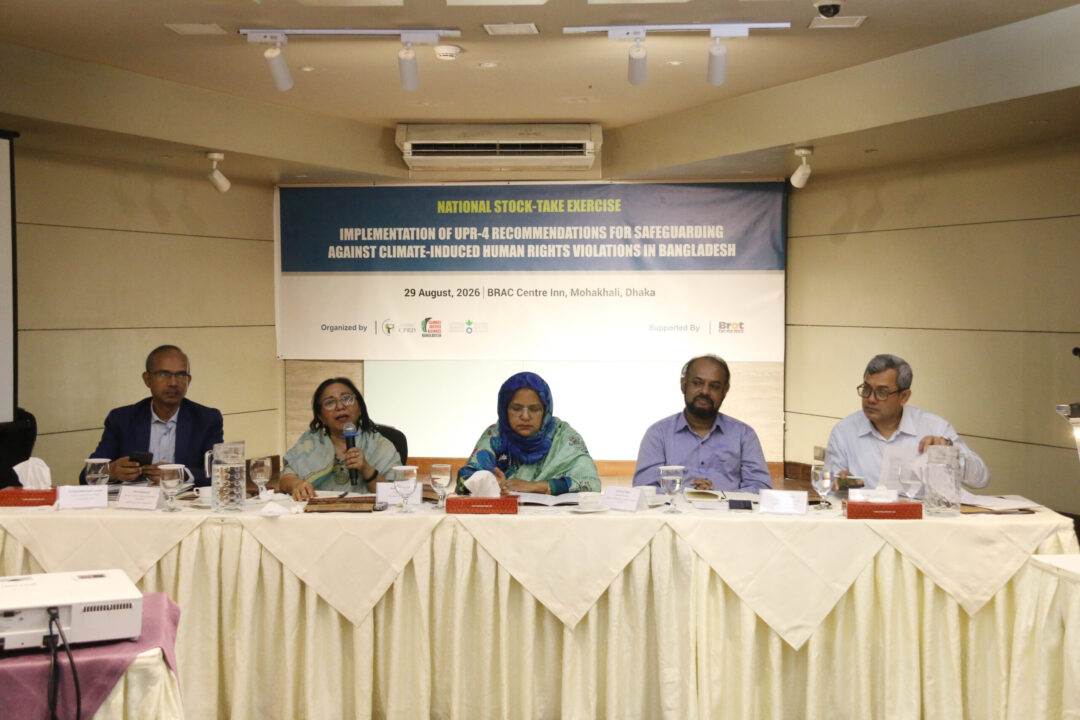
Climate Justice Alliance-Bangladesh (CJA-B), a platform of more than thirty CSOs, organized a press conference on 20th December, 2023 to share the outcomes of COP 28 to a broader range of policy stakeholders and CSOs. Md Shamsuddoha, Chief Executive of Center for Participatory Research and Development- CPRD and spokesperson of the Alliance, moderated the event titled ‘28th Conference of the Parties: Expectations Vs Achievements’.
Mr. Sheikh Nur Ataya Rabbi and Ms. Elmee Tabassum of CPRD jointly delivered a presentation on the key takeaways and unresolved issues of the COP 28. Referring to the CJA-B’s major expectations from COP 28, including complete phase-out of fossil fuels by 2050, roadmap on delivering the committed adaptation finance and long-term climate finance, agreeing-upon a proper definition of climate finance, establishing MRVs for the means of implementation, obligatory grants-based financing for addressing loss and damages (L&Ds), and so forth, the presenters explained that the COP 28 failed to produce any significant outcome in these regards— it rather frustrated and weakened some logical demands by nurturing the practice of loopholes and enshrining unjust decisions, such as, the decision on resourcing L&D fund as voluntary contributions instead of obligatory finances. On behalf of CJA-B, they claimed that the COP 28 outcomes conspicuously disregarded the historical responsibilities for climate change and the UNFCCC’s CBRD-RC and equity principles.


The presentation was followed by a panel discussion by a number of renowned CSO leaders, researchers, educationists, and journalists. Namely, Ms. Khodeja Sultana Lopa, Country Director at Diakonia-Sweden, Ms. Juliet Keya Malakar, Executive Director at CCDB, Professor Ahmed Kamruzzaman Mazumder, Chairman at Department of Environmental Science at Stamford University Bangladesh, Molla Amzad Hossain, Editor at Energy & Power, Syed Aminul Haque, Director at COAST Foundation, and Nikhil Vadra, Coordinator at Sundarban O Upokul Surakkha Andolon contributed to the panel discussion. Besides, journalists from the prominent media houses and members of CJA-B joined the press conference and took part in the discussion.
Ms. Juliet Keya Malakar said while climate change is already causing severe impact on the lives and livelihoods of the most vulnerable people, the COPs are wasting time and resources on the procedural issues. “It’s already 8 years since the Paris Agreement was adopted, and we are still playing around definitions, jargons, and terminologies”, she added.
Reiterating CJA-B’s advocacy for complete phase-out of fossil fuels by 2050, professor Ahmed Kamruzzaman Mazumder urged the countries for scaling-up targets of the NDCs so as to meet the requirement of limiting global average temperature rise to 1.5 degrees C. He expected that the COP 29 in 2024 would devise a just method of transitioning away from fossil fuels with specific targets and timeline.
Ms Khodeja Sultana Lopa provided a critical view on the decision on funding arrangements for responding to and addressing L&Ds. In her opinion, the establishment of L&D fund symbolizes global solidarity of addressing L&Ds, nevertheless the compromised decision of exempting the historical polluters from the obligation of needs-based financial contributions contradicts the global CSOs argument for climate justice. “The decision on resourcing L&D funds as voluntary contributions of both the developed and developing countries is also in a clear mismatch with the CBDR-RC principle of UNFCCC”— she maintained.
In his discussion, Syed Aminul Haque strongly criticized the role of COP, saying that the COP has turned into a market place for private sector investment and technologies instead of being party-driven negotiation. He also claimed that climate crisis has turned into an opportunity for the MDBs to expand loan market in the developing countries in the name of GHGs mitigation and adaptation. To him, the developed countries have defended MDB’s interest, disregarding the global stocktake’s advice for reforming the multilateral financial architecture and scaling up climate finance through grants and concessional finance.
Molla Amzad Hossain mainly commented on the COP 28 decision of ‘transitioning away’ from fossil fuels. In his view, this particular decision is very significant to strategize actions towards achieving 1.5 degrees Centigrade goal, however this should have been more specific with a timeline for phasing out. “What we need is a time-bound target for a deep emissions cuts supported by scaled-up finance in the developing countries”— he added.
In the concluding remarks, Md Shamsuddoha termed COP28 a further deviation from the CBDR&RC and equity principles of addressing climate crisis. In his analysis, decision on L&D funding modalities and institutional arrangements are not the ones for which the CSOs have been advocating for since long. Md Shamsuddoha castigated the imprudent decision of COP28 with respect to the role of MDBs, as globally, the MDBs, particularly the World Bank, has the history of financing for deforestation, fossil-fuel expansion and instigating climate crisis. In his words, other than the vague statement of ‘transitioning away from the fossil fuels’, there was no focused discussion and decision in the COP 28 on scaling-up GHGs emission reduction consistent with 1.5 degrees Celsius global warming pathway and mobilizing finances for enhanced mitigation and adaptation actions. He further commented that real progress in the key elements of addressing climate change was too slow across all areas of climate actions.

Against the milieu of some unsatisfactory and inadequate outcomes brought forth by the 28th Conference of the Parties, which may rather make the global climate change goal even more unattainable, the Climate Justice Alliance-Bangladesh expressed optimism for actions to ensure a safer future of the mother earth. The Alliance urged countries to step forward with ambitious, economy-wide emission reduction targets, covering all greenhouse gases, sectors and categories and aligned with the 1.5°C global warming limit in their next round of NDCs by early 2025. Stressing the necessity of means of implementation, particularly finance, the Alliance concluded discussion by demanding establishment of a new climate finance goal based-on need and exigency created by the climate challenge.