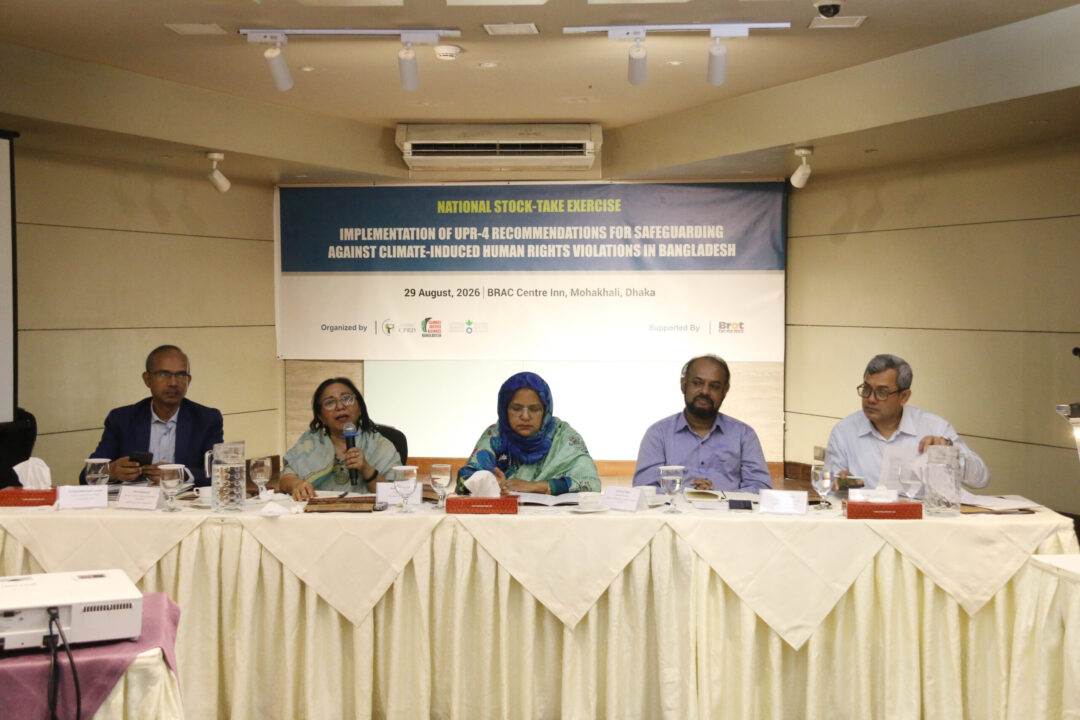
The Climate Justice Alliance- Bangladesh, a coalition of 42 civil society organizations secretariat by the Center for Participatory Research and Development (CPRD), convened a position paper-sharing event titled “COP 29 Position Paper Unpacking and Sharing: Articulating CSOs Position Together” on 5th November 2024 at the Six Seasons Hotel in Dhaka. The event aimed to present and discuss key civil society demands for COP 29, with a focus on climate justice and the need for ambitious and equitable climate action.
A brief on the development of the position paper was provided by Mr. Adnan Ibne Abdul Kader, Climate and Water Governance Specialist at WaterAid, followed by a detailed presentation of the CSO position paper by Sheikh Nur Ataya Rabbi, Assistant Manager at CPRD.
Md. Shamsudohha, Chief Executive of CPRD and Coordinator of the Climate Justice Alliance-Bangladesh, called for replacing the USD 100 billion annual climate finance pledge with need-based, predictable funding for vulnerable countries to support their transition from fossil fuels and enhance resilience. He urged developed nations to commit new funding to the Loss and Damage Fund (FRLD), ensure its swift operationalization, and create a dedicated financing window within the NCQG for reliable support. Furthermore, he emphasized the need for a framework to address climate-induced migration and displacement, with clear definitions, standardized terminology, and comprehensive data. Mr. Shamsudohha also stressed the importance of aligning the Global Stocktake (GST) with IPCC assessments and ensuring the effective implementation of GST-1 outcomes.
Reflecting on the position paper, the alliance emphasized the need for a standardized climate finance framework and an ambitious NCQG prioritizing concessional, grant-based, and publicly sourced finance, with a focus on vulnerable countries. They called for balanced funding between adaptation and mitigation, stronger gender-responsive approaches, and global collaboration on climate justice. The alliance also urged COP 29 to adopt ambitious NDC-3 aligned with the 1.5°C target, provide adequate financial and technical support for vulnerable nations, set a clear timeline for phasing out fossil fuels, finalize Article 6 of the Paris Agreement, and establish a framework for a just transition to a low-carbon future.
Dr. A.K.M. Saiful Islam, Professor at the Institute of Water and Flood Management at BUET, emphasized the importance of generating and disseminating scientific evidence on climate change impacts to inform the upcoming IPCC assessment reports and future climate action in an inclusive manner.
Shaheen Anam, Executive Director of the Manusher Jonno Foundation, stressed the need for reforms in the practices of Multilateral Development Banks (MDBs) and international financial institutions (IFIs). She called for greater alignment of funding practices with climate goals, simplified access to climate finance, and prioritization of equitable financing for mitigation, adaptation, and loss and damage.
Appreciating the position paper, Talha Jamal, Country Director of Islamic Relief Bangladesh, commended CPRD’s leadership in bringing together civil society organizations around the demand for climate justice. He called on government representatives to give serious consideration to these demands while taking decisive action on them at COP 29.
Among other participants, Sharif Jamil, Member of the Board of Directors at Waterkeeper Alliance and Member Secretary at DHORA; Hasin Jahan, Country Director of WaterAid Bangladesh; Juliate Keya Malakar, Executive Director of CCDB; Rabeya Begum, Executive Director of SDS; and Prashant Verma, Country Director of Helvetas Bangladesh, along with senior government officials, CSOs, and development stakeholders, all called for COP 29 to adopt fair, accessible, and rights-respecting climate finance mechanisms.