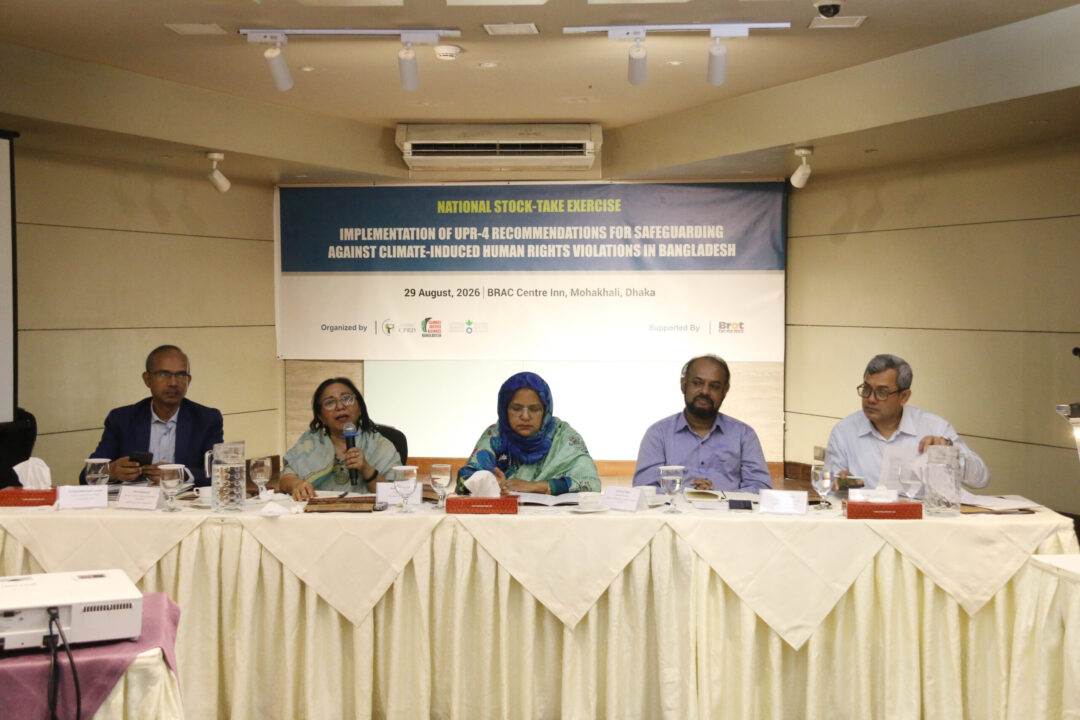
On 29th August 2026, the Center for Participatory Research and Development -CPRD, Action Against Hunger (ACF), and the Climate Justice Alliance-Bangladesh jointly organized a national advocacy seminar titled “Stock-Take Exercise on the Implementation of UPR-4 Recommendations for Safeguarding Against Climate-Induced Human Rights Violations in Bangladesh” at the BRAC Centre Inn, Dhaka.
The seminar explored the implementation progress of the relevant recommendations supported by the Government of Bangladesh during the 4th Universal Periodic Review (UPR) cycle, one of the most viable entry points for integrating climate-induced human rights issues into existing global obligations. Mr. Sheikh Nur Ataya Rabbi, Assistant Manager of CPRD, mentioned that during the third UPR Cycle in 2018, the Government of Bangladesh supported two climate-related recommendations for addressing and mitigating the negative impacts of climate change. Both of them were implemented in the due cycle. However, evidence showed that the ever-growing climate change impacts remain a fundamental driver of human rights violations across the country. Building on this, a coalition of 15 CSOs led by CPRD made a joint submission during the 4th UPR Cycle in 2023, with evidence of climate-induced human rights violations and a proposed set of strategic actions across seven thematic areas. This statement was globally presented and highly appreciated at Geneva in 2023. Eventually, the GoB accepted 12 recommendations for implementation during 2024–2027. He also presented critical implementation gaps and practical policy and action pathways to strengthen the protection, promotion, and fulfillment of human rights in the context of climate change.

Reiterating the implementation challenges, Md. Shamsuddoha, Chief Executive of CPRD, urged that now it is time to follow up on how far these pledges have been translated into policies, programs, and actions, and to identify the pathways to address the gaps.
Ms. Shaheen Anam, MBE, Executive Director, MJF, emphasized the continuation of such efforts among human rights defenders, climate change experts, academics, and CSOs in protecting human rights violations against climate-vulnerable and frontline communities in Bangladesh.
Md. Ziaul Haque, Additional Director General, DoE, acknowledged that the Government of Bangladesh is concerned about the climate-induced violations in the country; and a coordinated effort is also required to significantly enhance its institutional capacity to ensure adequate safeguards.
Dr Fazle Rabbi Sadek Ahmed, Former Additional Secretary, DoE & DMD, PKSF, highlighted the need for stronger institutional coordination, systematic monitoring, evidence generation, and sustained policy advocacy.
As the Chief Guest, Dr. Nurun Nahar, Additional Secretary, Ministry of Environment, Forest and Climate Change, stated that the worst impacts of climate change affect marginalized communities, especially women, children, migrant people with no identification, or socially isolated communities. However, international climate negotiations have yet to adequately institutionalize mechanisms for addressing these climate-induced violations, which remains a major concern for us.
The event brought together policymakers, human rights experts and defenders, climate change experts, academics, researchers, and civil society representatives. The participants agreed to extend such efforts to stocktaking the implementation of the recommendations Bangladesh has supported and gathering evidence may any discrepancies be identified.