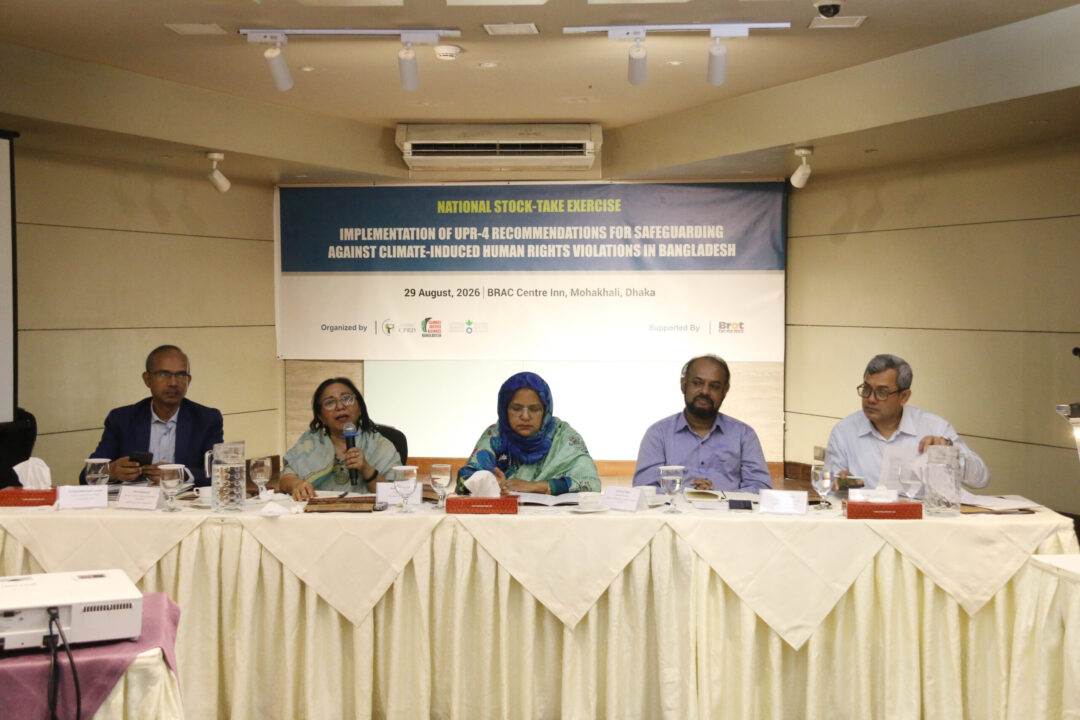
Despite escalating climate-related health risks in Bangladesh, climate-health financing is moving in the opposite direction. The Center for Participatory Research and Development (CPRD) has recently conducted two timely studies on the climate impact on women’s reproductive health and current climate-health financing in Bangladesh. To disseminate findings and facilitate high-level policy dialogue, CPRD, in collaboration with HEKS/EPER and Shushilan, organized an event titled “Study Sharing and Policy Dialogue on Climate-Resilient Health System and Health Financing in Bangladesh” on 06 June 2026 at BRAC Centre Inn, Dhaka.
During this session, Shohahur Rahman and Md. Shahadat Hossain, from CPRD, presented the first study titled “Assessing the Impact of Climate Change on the Reproductive Health of Coastal Women and Adolescent Girls.” This study documents significant reproductive and maternal health challenges among women in the coastal area, driven by poverty, water scarcity, and climate-related vulnerabilities. Respondent women in this study reported a wide range of menstrual health disorders (nearly 50%), including irregular cycles, dysmenorrhea, amenorrhea, and abnormal bleeding alongside serious pregnancy and post-delivery complications, such as miscarriage, pre-eclampsia, infections, postpartum hemorrhage, and chronic pain. Limited access to clean water and basic sanitary products compounded these challenges considerably, as 82.5% of the respondents observed. In addition, a substantial number of women were found to have symptoms of Pelvic Inflammatory Disease (PID) (86%), with laboratory tests confirming gynecological infections among many of them.
These escalating health crises could be systematically managed with strong policy backing and dedicated resources, but a critical disconnect persists on the ground. Despite health being explicitly recognized within the country’s key climate policy frameworks, this strategic commitment has not translated into adequate or sustained climate finance. Ms. Sumaiya Binte Anwar, Program Manager of CPRD presented the second study, “Climate Finance for Health in Bangladesh: Policy Ambition and Fiscal Reality,” which reveals a stark and consequential mismatch between what Bangladesh’s climate policies promise and what its budgets actually deliver. She pointed out that despite policy progress through instruments such as the Health National Adaptation Plan (HNAP), climate-health priorities remain weakly integrated into budgeting systems. The study highlighted that climate-relevant allocation within the Health Services Division declined from 2.74 percent of its total budget in FY2021–22 to 1.97 percent in FY2025–26, despite increasing exposure to climate-related health threats across Bangladesh. Health’s share of the national climate budget also declined over the same period, from approximately 2.5 percent to 1.5 percent. The research further found that less than one percent of Bangladesh Climate Change Trust Fund (BCCTF) financing has been allocated to health-related projects. Of the 877 projects financed through the BCCTF as of 2024, only three projects were implemented through the Health Services Division. The study also highlights major structural weaknesses in climate-health financing.


This argument brought together relevant policymakers, public health experts, researchers, development partners, civil society representatives, academics, climate specialists, and media professionals. The session was facilitated by Md. Shamsuddoha, Chief Executive of CPRD. The discussants emphasized the due integration of public health systems, fiscal accountability, and institutional preparedness in health adaptation planning. Mr. Shah Abdul Saadi, Deputy Secretary, Economic Relations Division (ERD), discussed the institutional, governance, and financing barriers affecting climate-responsive health adaptation in Bangladesh. Prof Dr Md. Iqbal Kabir, Director, Director, Climate Change and Health Promotion Unit (CCHPU), Health Service Division, Ministry of Health and Family Welfare (MOHF), also contributed to discussions on fiscal transparency, inter-ministerial coordination, and equitable resource allocation for vulnerable populations.
As the Chief Guest, AKM Sohel, Additional Secretary and UN Wing Chief at ERD, underscored the need for increased public investment in climate-responsive healthcare infrastructure, surveillance systems, workforce capacity, emergency preparedness, and long-term health system resilience. He urged, “The loss and damages related to health must be counted as economic ones. That will enable us to generate a cost-investment plan for accessing global climate funds.”
The dialogue generated a set of evidence-based recommendations ahead of the FY 2026–27 National Budget and has called for urgent reforms to Bangladesh’s climate-health financing system.