Centre for Participatory Research and Development (CPRD) hosted a two-day workshop between 27th and 28th September 2025, at the Daily Star Centre, Dhaka, on “Climate Building Workshop on Critical Aspect of Climate Science, Impacts, and Policy Negotiations Under the UNFCC”. The workshop was collaboratively organized by CPRD, The Climate Watch, Climate Justice Alliance, and Bangladesh and Young Climate Action Network (YOUCAN), with the support of Bread for the World and GSCC.
The workshop was organized to strengthen the knowledge, skills, and collaborative capacities of young media professionals and CSOs, build capacities on policy and political dynamics in advancing climate action, and enhance understanding of global climate negotiations and their relevance for national policy processes.
The two-day workshop encompassed a diverse range of thematic sessions related to climate science, its impacts, and policy negotiations. The first day of the workshop provided a scientific perspective on climate change, including its impacts, both economic and non-economic losses and damages, the human dimension of climate change, and climate negotiations, through expert presentations. Professor A.K.M. Saiful Islam, IWFM, BUET, one of the leading scientists in climate science, discussed the scientific basis and evidence of climate change and its impact, based on the IPCC’s Sixth Assessment Report. Following that presentation, two research officers from CPRD, Rai Dhar Ruchi and HM Rayhanul Islam, presented the human dimension of climate change and shared case stories of people affected by climate change in Bangladesh. Elmee Tabassum, from MicroSave Consulting (MSC), presented the economic and non-economic losses and damages scenario in Bangladesh due to climate change.
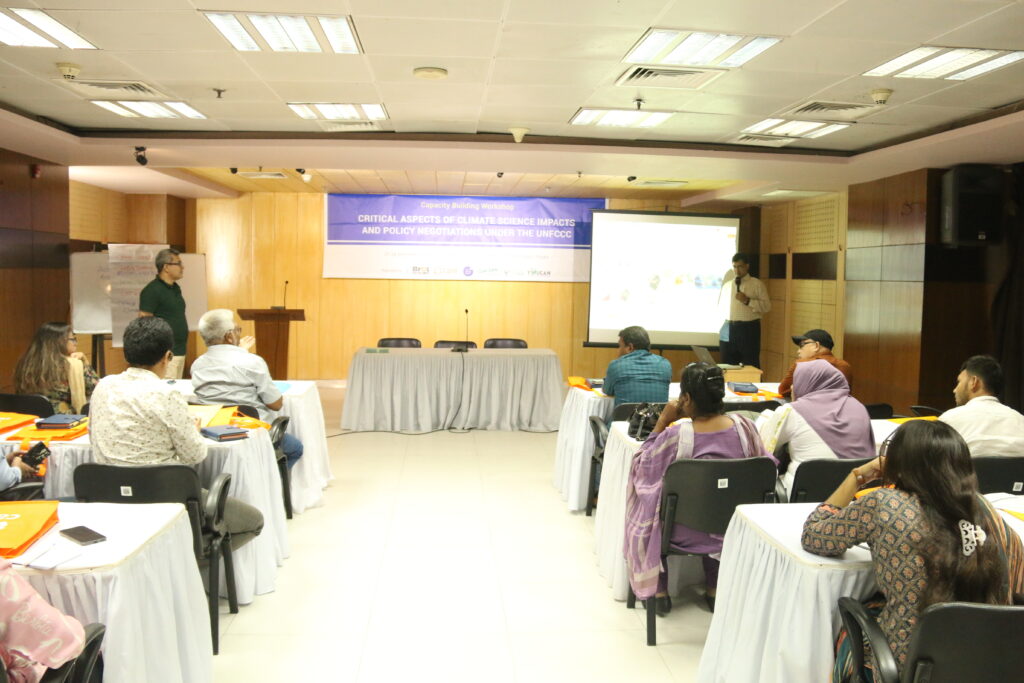

Md. Shamsuddhoha, Chief Executive of CPRD, presented a brief history of climate change negotiations. He discussed the history of the IPCC and UNFCCC, policy negotiations at various COPs, and an overview of climate financing. The first day concluded with another expert presentation by Shahnawaz Whara, Advisor at Concern Worldwide Bangladesh. He presented the climate-induced disaster and humanitarian action in Bangladesh.
Building upon the overview of climate science and policy negotiations from the first day, the second day of the workshop continued with a thematic session on climate change adaptation and mitigation. The deputy director of CARE Bangladesh presented the concept of nature-based solutions and talked about its scope and examples in Bangladesh. The core idea of the presentation was to provide an overview of localizing climate change adaptation. Following the presentation, Shafiqul Alam, lead energy analyst at IEEFA, talked about climate change mitigation. His presentation covered the concept of a just energy transition, an overview of the global policy narrative of just transition, and the scope of just transition in Bangladesh. The second day also covered an additional session about COP process. Sheikh Nur Ayat Rabbi, Program Manager of CPRD, presented the reflections from COP29 outcomes. In the presentation, he briefly discussed the key insights from COP29 and highlighted the key debate issues at COP30, as well as the CSOs’ position on those. In a later session, Shamsuddin Illias, the executive director of The Climate Watch, discussed the reporting and engagement process with COP.
The second day ended with a panel discussion focusing on the fostering role of youth, media, CSOs, and local government in influencing inclusive development and climate action. Experts and youth representatives from various NGOs and CSOs participated in the discussion. The panel discussion brought together diverse voices from academia, government, CSOs, and the media.